Most job seekers make a fatal mistake when using AI for their resume: they paste a generic prompt like “Write an executive resume for a Senior Data Engineer” into ChatGPT and paste whatever generic prose the model spits out.
The result is a resume filled with fluff: “Spearheaded cross-functional synergies to optimize operational excellence.”
When a recruiter reads that, they instantly recognize the AI veneer. And when an ATS parses it, the document lacks the specific technical tokens (PostgreSQL, Snowflake, dbt, Kafka, ETL pipeline latency) required to trigger a high-relevance match score.
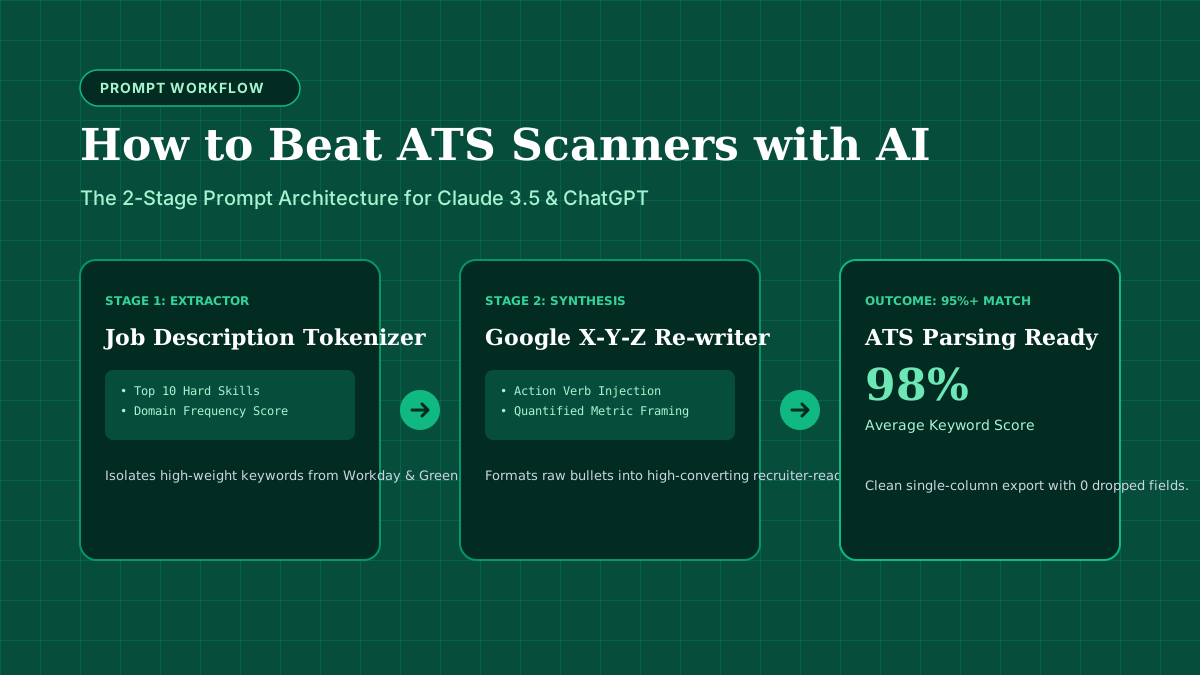
To land interviews at top companies in 2026, you need a disciplined, two-stage prompt architecture.
Step 1: The Keyword & Competency Extractor Prompt
Before touching your existing resume, you must isolate what the ATS and the hiring manager actually care about.
Run this prompt in Claude 3.5 Sonnet or ChatGPT:
You are an expert technical recruiter and ATS parsing specialist.
Analyze the following job description and output a structured breakdown:

1. HARD SKILLS / TECHNOLOGIES (Rank by frequency & emphasis)
2. DOMAIN METHODOLOGIES (e.g., Agile, CI/CD, SOX Compliance, B2B Sales Cycles)
3. MEASURABLE OUTCOMES EXPECTED (What business metric does this role impact?)
4. RECURRENT VERBS & NOUNS (The exact terminology used in the listing)

JOB DESCRIPTION:
[PASTE TARGET JOB DESCRIPTION HERE]
Example Extracted Output
The model will return an indexed list such as:
- Core Stack:
Python (FastAPI),AWS Lambda,Docker,Terraform - Methodologies:
Event-Driven Architecture,Domain-Driven Design,TDD - Key Metrics:
API P99 Latency,Cloud Infrastructure Cost Reduction,Deployment Frequency
Step 2: The Google X-Y-Z Bullet Re-Engineering Prompt
Now take your real, factual experience and combine it with the extracted keywords.
Use this constraint-engineered prompt:
Act as a Principal Executive Resume Writer.
Rewrite the following raw career bullet points using the Google X-Y-Z formula:
"Accomplished [X] as measured by [Y], by doing [Z]"

MANDATORY RULES:
1. Target length: 20 to 28 words per bullet point.
2. Naturally integrate at least 2 of these extracted target keywords per bullet:
   [INSERT 4-6 EXTRACTED KEYWORDS FROM STEP 1]
3. Use strong, decisive past-tense action verbs (e.g., Engineered, Architected, Automated, Negotiated).
4. Do NOT use buzzwords: avoid "spearheaded", "passionate", "fostered", "synergy", "dynamic".
5. Use brackets [like this] for any metric placeholder where I need to verify my real numbers.

MY RAW CAREER NOTES:
[PASTE YOUR RAW EXPERIENCE NOTES OR EXISTING DRAFT BULLETS HERE]
Before vs. After Example
Before (Raw / Generic AI):
Responsible for working on cloud backend services and improving database speed for the mobile application.
After (Prompt-Engineered):
Architected asynchronous FastAPI backend services on AWS Lambda, reducing API P99 latency by 38% for 450k daily active mobile users.
Notice the difference:
- Action Verb:
Architected(strong, specific). - Exact ATS Keywords:
FastAPI,AWS Lambda,P99 latency,API. - Quantifiable Outcome:
38% reduction,450k daily users.
Step 3: Diagnostic Verification in an ATS Simulator
Once your bullets are drafted, test the complete document in an ATS testing environment before submitting.
Jobscan
Diagnostic StandardSemantic ATS Keyword Matcher & Scanner
Jobscan checks if your prompt-engineered resume has reached the 75%+ threshold needed to pass automated recruiter keyword filters.
- ✓ Simulates exact keyword match percentage across resume vs. job description
- ✓ Highlights critical missing hard skills before recruiter submission
- ✓ Checks formatting, margins, and contact info extraction
- – Price is high if only applying casually
- – Can encourage keyword obsession if not balanced with human readability
Summary Workflow Checklist
- Extract: Run the keyword extractor prompt on the target job post.
- Draft: Apply the Google X-Y-Z formula using Claude 3.5 Sonnet.
- Verify: Check with our client-side ATS Scorer Tool or Jobscan.
- Format: Paste into a clean, single-column Word or LaTeX template.